

- Alphonse Island Farm
- 13 October 2026
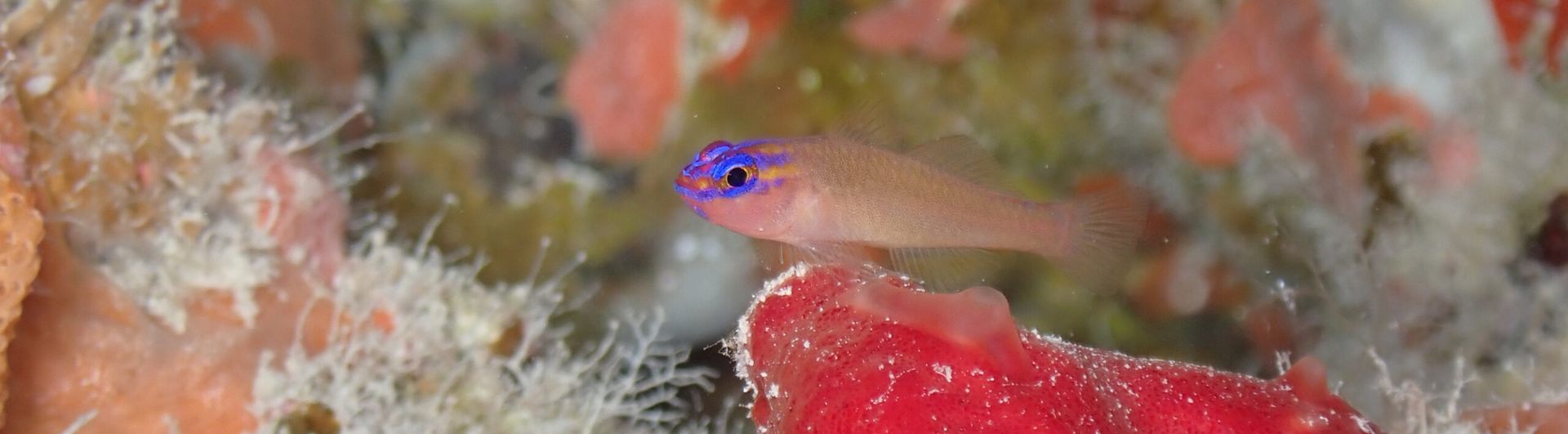
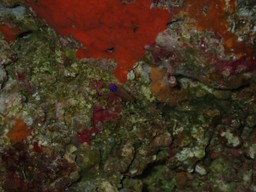
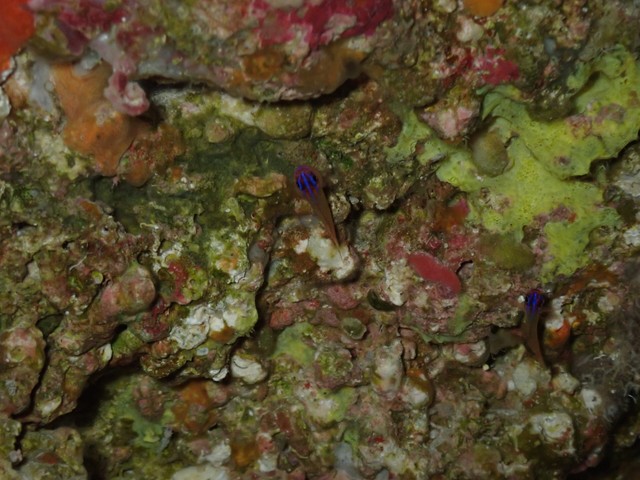
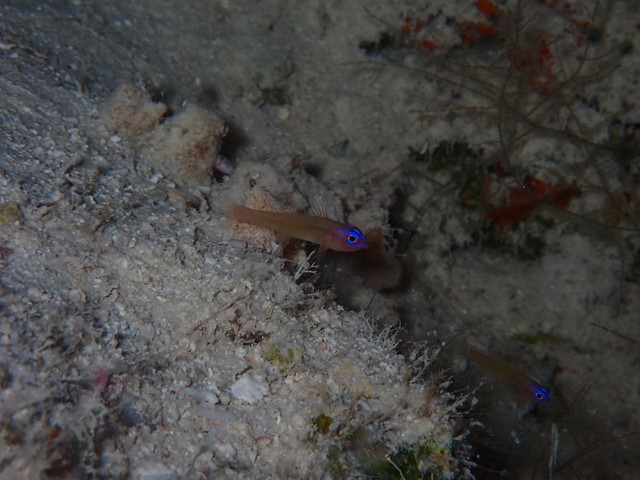
On 28 February 2022, Blue Safari’s Conservation and Sustainability Manager Elle Brighton was 26 metres down on the western side of St François Atoll, working through a cave at a dive site called Theatre. She was midway through a fieldwork run that would total 44 hours underwater across 12 days, photographing every fish she and her colleaguescame across for a rapid assessment of fish biodiversity across the Alphonse Group. Most of what was seen saw that trip they could identify on sight. This one, small enough to sit across a fingernail and marked with three electric-blue stripes across its head, she couldn’t place at all.
Pygmy gobies, the group this fish belongs to, are notoriously hard to pin down. The genus Trimma alone held more than 110 described species at the time, and taxonomists have long suspected many more are hiding among specimens too small, too similar, or too rarely collected to have been properly told apart. A related pygmy goby, Eviota daylii, had turned up new to science during a comparable survey at D’Arros in 2018. The team had reason to think this could be another one, and reason to be careful about saying so.

From photograph to specimen
Photographs were sent to two of the field’s leading gobiid taxonomists, Mark Erdmann and Rick Winterbottom, Curator Emeritus at the Royal Ontario Museum. Their first read was that it might simply be a colour variant of Trimma dalerocheila, a red-headed pygmy goby already known from Seychelles waters. Without specimens for genetic testing, there was no way to be sure. Over the following year, Elle and Christophe Mason-Parker of the Marine Conservation Society Seychelles collected samples and sent them, with further photographs, to Winterbottom in Canada.

What the DNA showed
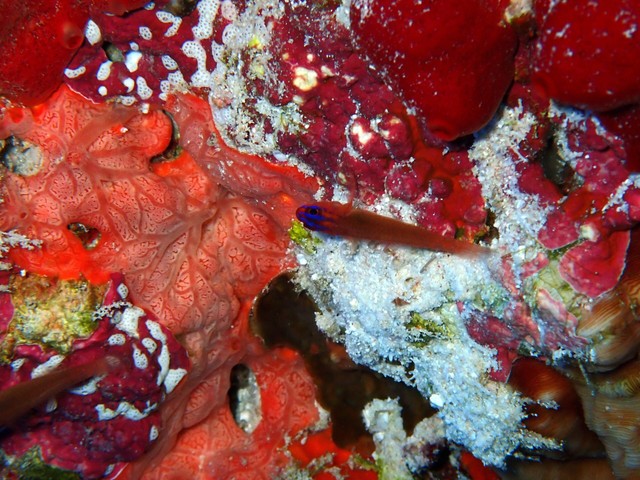
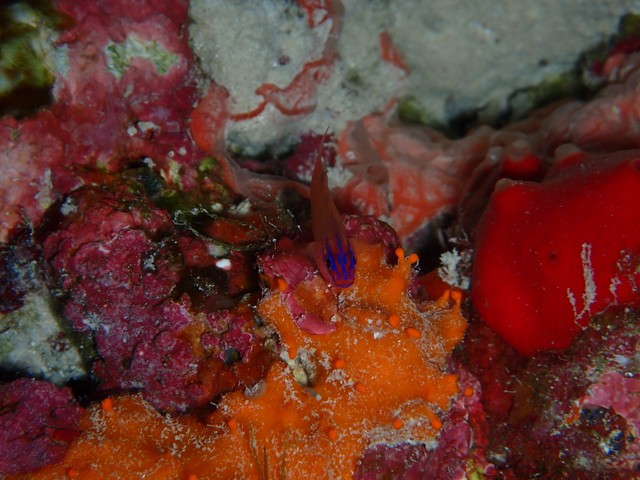
The DNA told a different story. Under COI barcoding, the genetic marker most commonly used to distinguish fish species, the new goby differed from its closest known genetic relatives, Trimma halonevum and Trimma putrai, by around 18 per cent, a gap far beyond what typically separates one species from another. Its nearest match under traditional classification, Trimma maiandros, turned out to be a poor fit too: different fin-ray counts, different proportions, and an entirely different colour pattern (maiandros carries a ring around the eye and yellow, saddle-shaped markings along its body, rather than the new fish’s three stripes of blue confined to the head). Elle’s instinct in that cave had been right.
Winterbottom, Elle and Mason-Parker formally described the species in the Journal of the Ocean Science Foundation, published 18 July 2024, just over two years after that first photograph. They named it Trimma cavicapum, an arbitrary combination of letters derived from the Latin for blue (caerulus), stripe (virgatus) and head (caput). The proposed common name is the bluestripe pygmygoby. The holotype, a 20.7-millimetre female collected south of Bijoutier Islet, is held at the Royal Ontario Museum in Toronto.
“I’d spent 44 hours underwater in the 12 days before finding it, photographing every fish we came across, and I’d logged hundreds of survey dives before that,” Elle says. “As soon as I saw it, I knew it was something special, not a fish I’d seen before. It was initially dismissed as a colour morph of a known species. I pushed to get it genetically coded and compared anyway. I’m very thankful we did.”
Where it lives
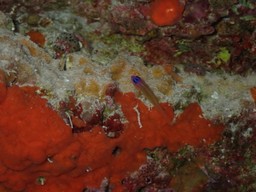
The bluestripe pygmygoby lives in crevices and caves on steep outer-reef walls, typically in pairs or small groups, alternating between resting on the reef and rising a short distance above it before settling back in the same spot. It has been confirmed at three sites around Alphonse Atoll and at Theatre on St François Atoll, and was recently photographed at Astove, 645 kilometres to the south-west. Despite a dedicated search through the rest of the Amirantes chain in 2024, it hasn’t turned up anywhere further north, which makes the Alphonse Group and Astove, for now, its entire known range.
A new species doesn’t get discovered by accident. It takes exactly this kind of work: years of methodical underwater survey, expert consultation, specimen collection and genetic analysis, carried out by Elle and Mason-Parker with the Alphonse Foundation, the Marine Conservation Society Seychelles and the Island Conservation Society, funded through SeyCCAT and supported in kind by Blue Safari. The same survey extended the known range of more than seven other species beyond what had previously been published, the kind of baseline data that matters most in places still this underexplored, and increasingly urgent to gather as remote reef systems face mounting pressure from climate change.
Seeing it for yourself
Guests diving Theatre, Arcade or Shark City with a torch in hand stand a real chance of spotting one tucked into a crevice below 18 metres; Alphonse’s dive guides are trained to point it out. It’s beyond snorkelling depth, but for divers, it’s one of a small number of newly described species anywhere that guests can go and see for themselves, on the exact reef where it was found.
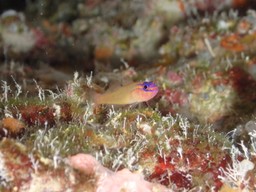
Two more candidates are already on the list: a jawfish and a yellow damselfish with markings that don’t quite match anything published. Confirming them will take the same thing this one did, patient fieldwork, expert eyes and, eventually, samples in a lab far from Alphonse.
previous blog
- Share:


next blog